Sunday, October 9, 2011

Nihon no Tabemono I (free-form)

Welcome to the world of Japanese food. Read at your own risk (of getting extremely hungry and/or drooling on your computer). Some of the food looks more questionable, but let me assure you that if it does not taste good, I will put it on a separate post saying "what not to eat in Japan." The above picture is of a small garden placed at the back of a manju (Japanese baked sweet) shop in Okayama. Complementary tea is available to guests who wish to enjoy the quiet serenity of the garden as they eat - assuming they are not afraid of giant carp....


This is said manju, the Okayama manju (quite famous) along with fresh tea. The presentation was prepared by the grandmother in my second host family, who practices ikebana (flower arrangement). I must say, it is gorgeous, and for a second (half a second, really - which is about as long as it took me to take this picture) I hesitated to eat it.


Perhaps this is less appetizing in appearance, but it is essentially my favorite desert turned inside out. The inside is white rice, the outside a thick coating of creamy red bean paste. Note that the bean skins are visible in the bean paste - there is also a type of bean paste where the skins are removed, and it is a topic of hot debate here which is the appropriate way to prepare your red bean paste. Go figure. I'll eat it either way, so whoever loses...send me the leftovers.


Another famous Okayama food is Okanamiyaki. The Okayama version has distinct layers, including soba noodles, eggs, their famous sauce, green onions, and some other fillings (depending on your order). Mine, not surprisingly, was filled with seafood, including ebi (shrimp) and squid. The Kyoto version is distinct in that everything is mixed before grilling, making for a more solid composition of egg encrusted deliciousness. Either way, I find it delicious, but I prefer the Okayama version - again, for those who know me, I always pick apart my food, so that is most likely not surprising. The food is grilled and then placed on a grill in front of you, where it is ingeniously kept warm while you eat it bit by bit. Industrious. I want one of these in my house.


One really annoying aspect of photographing food - pictures like this, where my perfectly delicious taco (octopus) is blurry but the menu behind it crystal clear. Go ahead, read the menu. This was too small for 800 yen, but based on the other food, that is a reflection only on the expense of the raw materials. It was worth the price to try it.


Now this, my friends, is what Ramen should look like! Fish, eggs, and rice, served with a delicious soy sauce based broth. Ramen shops are all over Kyoto, and some are better than others. This one is on Higashiyoji, just left from Imadegawa. Enjoy.


And what food blog would be complete with out Om-rice, or the famous Japanese rice omelet. This one is a seafood omelet (I have also had the ketchup covered version) replete with shrimp, squid, octopus, and various things whose names I do not know. Amazing.


Japan is also famous for its dango. These are squishy balls of pounded rice that are virtually flavorless without the sweet sauce that coats them (powders and other things are also used, especially on less firm versions of the sweet like the Okayama kiwi dango). They also go in order of body parts, with the end of the stick being the head. Yes, I had this conversation with the ojisan who sold them to me, as I was the only one eating at his tiny shop at the time (there is no front door, just many red-clothed benches). Those kinds of shops are fun, incidentally, as he served me tea and we chatted as I ate. It was fun. On the other hand, I bought some larger dango on a long bus trip and made myself sick off of them (I only ate 4). The rest are currently molding in the corner of my room, so be careful not to buy more than you can eat.


To finish up with a better image than that of moldy dango, here is a waffle served at a flower shop in Kyoto. Those are apples and cream, coated with just the perfect spices to give that classic "Autumn" feeling. The waffle had a rich flavor of eggs and cream as well. Mmmm, good.
Look forward to more in the future.

sugoi toire (Special: My Potty!!)

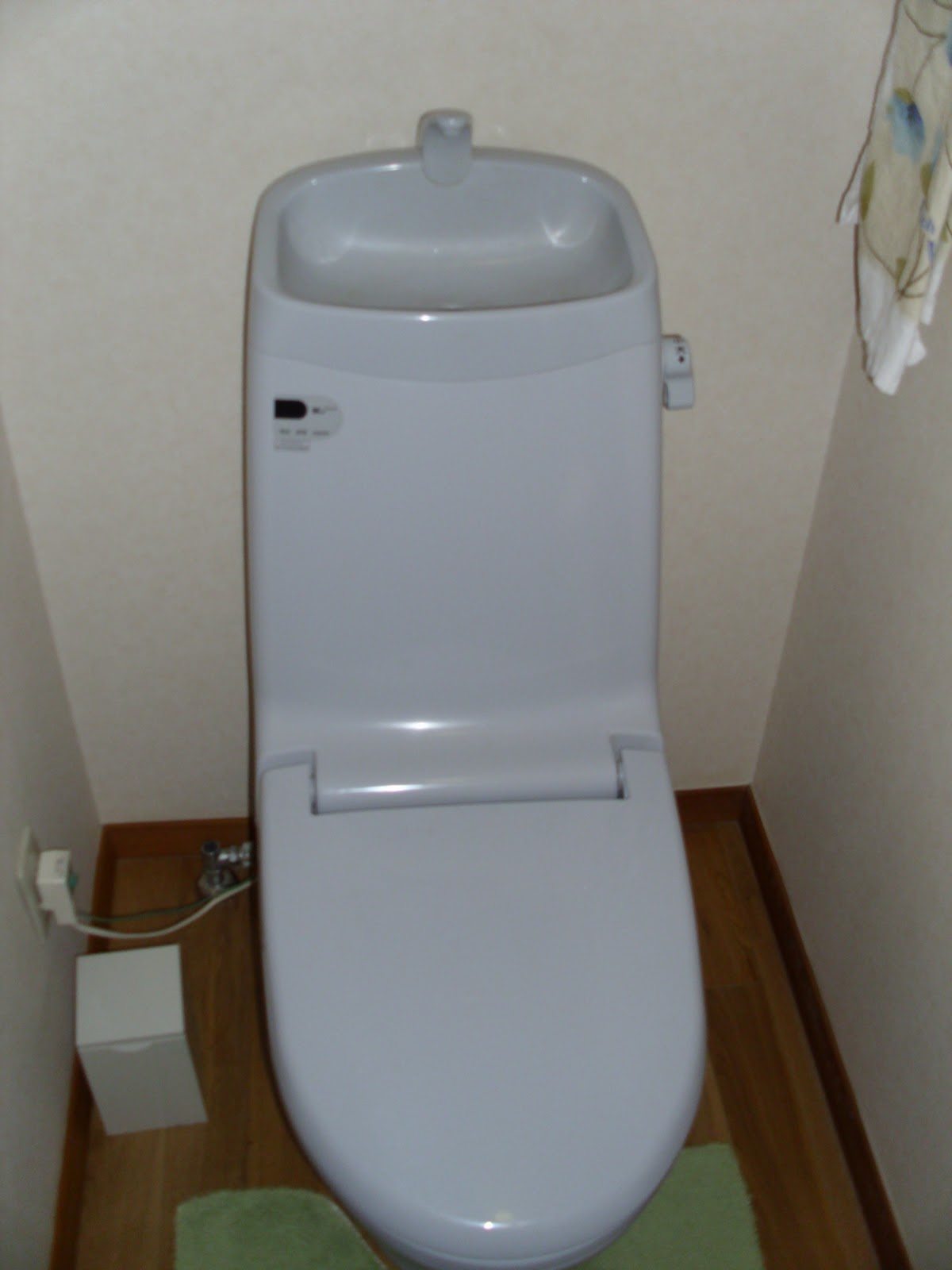
So, finally, the promised low down on Japanese toilets. There really isn't much to say. I think I'll let the pictures do most of the talking. IThe top picture is of "my" toilet (who I see 3 times a day). My toilet is a beautiful shade of maroon, and has all the necessary buttons (large or small flush, various spray options, etc.). The second one was at another house, and has a strange device at the top that poors water whenever the toilet is flushed. Why? Someone will one day tell me.


What exactly does NG stand for? Perhaps "No Go."


At any rate, stand facing the flusher (or rather, squat). Actually, I rather like these toilets better than the normal kind. There is no sitting, either, so no need to cover the seat.


They use magical non-foaming soap here. I think it's real. I am not sure....


If you really need to "use the restroom" in Japan, look for a rest station. Unlike American rest stations, these include various shops and stores for gifts, food, and dinner, restaraunts, coffee shops, and a place to park. There is also a five star bathroom, kept conspicuously well-lit and clean (and shiny), stocked with fresh flowers, 20-30 stalls (western and Japanese style), and many mirrors.


Just saying. :)

Undoukai (serious)

Beautiful fall weather, akibane as it is called in Japan, is a magical thing. Somehow today, the hollow chill of Autumn faded away, replaced by the scent of dust and of an earth baked by the heat as the sun beat down from a perfectly sapphire blue sky. That sky was hemmed on all sides by an imposing cement building, its dark windows and broad doors somehow characteristic of a school. On its other side was a tangle of trees and plants, home to an impossible number of bicycles (and normally a playground). Perhaps the sheer number of bicycles bespoke the fact that there was nothing like silence in the background - the sounds of scuffling feet, mild chatter, and instructions spoken over a loudspeaker were anything if not deafening. This, my friends, was the backdrop for the local undokai, or sports festival.
Let me say only this: if you have the chance to attend one of these, and better yet, to participate, do so! Events range from any number of races (simple relays, relays where you hold a ball behind your back and grab bread in your mouth before running to the finish, others where you fill a ladel with water and try to be first to fill a bottle of water several yards away, etc.), tug-of-war, rock-paper-scissors, etc. Few of these are singular events, which makes for a wonderful group dynamic. Of course, that group dynamic actually is quite interesting, as it is normal to thank each member of the group after each event, bowing your head a bit and then continuing conversation as if nothing happened. There are also prizes for almost everything, and by prizes, I mean toilet paper, tissues, food, and other house supplies. Haha! You have to love the people here for their practicality, and indeed, I was as happy to get seaweed and bread as anyone else.
I saw similar attention to group dynamics when I went to tennis lessons yesterday. I practiced with many people much older than me, but felt that I fit right in (I have been teased for years about appologizing and smiling constantly while playing). True, these were hardly championship games that we were playing, but the sportsmanship was still admirable.
In terms of people much older than me, I can say also that at today's undokai, it was not only children and their parents running the marathons. There were sixty and seventy year old men and women running, grinning, barroling into each other on the dirt track. Several of them took nasty falls, and like an old ninja in an anime, sprang right back up and kept running. The elderly here really are amazing. I hope American grandparents can one day be able to live their lives with such vigor (though there certainly are some American grandparents who do just that already, of course).

Thursday, October 6, 2011

Eigo ga hanaseru? Free Form


I will begin by observing that I am horribly behind in my blog topics. If time permits, I plan to complete several posts this weekend, so stick with me. Food, toilets, and several day trips are in the works. I will also be updating the do's and don'ts blog, so check back if you would like to read more about that particular topic. What I would like to discuss today is the experience of being invited as a "native English speaker" to an English speaking club. Objectively, it seems like a relatively simple thing - in reality, it is anything but simple. To illustrate this point, let me start at the beginning.
I was invited for a mutually beneficial experience to a medical english speaking club. The one who invited me was president of the club (a student like myself) and also a family friend (for my host family). One thing that anyone coming to Japan will quickly learn is the concept of pressured decisions, though I believe they are not something new to most people - when you go over to a friends house for the first time, for example, and their mom gives you chocolate ice cream when you really want vanilla, you eat the chocolate one because you're a good kid and know not to look a gift horse in the mouth. Anyway, I wanted to accept the offer made by this person anyway, because I was curious, but looking back I realize that even if I had wanted nothing to do with the club I would probably still have said yes. He invited several of my friends along as well (or rather, suggested that more would be merrier) but as my class unfortunately had an essay due the next day, I ended up going alone.

So, now I will say something that I think is true of any expedition for discovery (which going to Japan certainly is): if you go alone, you are bound to have a richer experience than if you go with other people. The group dynamics are entirely different when you are in a group of your own - meaning, you are unnapproachable and unwilling to leave the sphere of your personal comfort zone. No worries, it's normal, but stepping outside of that is the surest way to really (really as in actually) encounter another culture. I encountered another culture when said president swung open the door of the classroom and I was greeted by twenty or thirty pairs of eyes. Now the feeling here was uncomfortable in the sense only that I was clearly the center of attention. In fact, I believe I immediately realized I was about to be spoiled beyond belief. Sure enough, I was gestured in with the prefunctury "doozo, doozo." My shoes I removed uncertainly, and my host stepped past me to carefully align a pair of slippers on the other side of the shoe blockade. One person brought me a chair (placed neatly at the front of the room while everyone else sat at tables) and another gave me a choice of drink - in my somewhat overwhelmed state I simply thanked her and took one (rather than expressing a desire for one flavor over the other). This illicited genuine laughter and nervous laughter both. Thankfully (for my too-quickly-beating heart) the president quickly began the meeting, and asked me to introduce myself. English or Japanese is good, he said. Well...I explaind briefly in Japanese that since it was an English speaking class, I would use English. And so I did.
Interesting point number two: "a native speaker of English" is a thing. A valuable commodity, in a sense. Foreigners in the past have likened it to being a particularly rare speciment in a zoo - I think it is a more pleasant experience than that, assuming the people around you were like the wonderful people of this club and were positively brimming with welcome. You do, however, feel a very tremendous sense of expectation. When you speak, you can feel the attention in the room shift. You are the guest of honor, and, I have to humbly say, for the average American person that is very rare.
Interesting point number three: meeting with the individual people, at least in this case, required dividing up (for which I felt even worse that I had needed to report that none of my friends could actually come - not my fault, but still, when you are treated so carefully, there is a strong sense that you should deliver in full!). Introductions were carried out among each group, and then the questioning began. Generally, the conversation was made up of people asking me questions about my thoughts about Japan, favorite foods, and so forth. I spoke entirely in English to one group, entierely in Japanese to two others. Part of this was, I am sure, out of respect to the fact that I was there to learn Japanese, even if I had agreed to help them with English. Part of it might also have been because they felt more comfortable speaking in Japanese. I have experienced as well that it is easier to encounter new people, and to befriend them, when you use a language you actually understand (I might have suffered a bit there since we were speaking in Japanese).  We had assigned topics of conversation, but with each group, things quickly devolved to a simple question and answer session. It was fun, so I'm not complaining. I certainly got a lot of practice, and I hope they did as well.
Interesting point 4: the most difficult part of these sorts of meetings is the moment when you don't understand. Pretty soon, you have ten or fifteen people trying to explain a word or concept to you, and trying very, very hard. Everyone has endless patience. It makes you feel just a bit dumber with each explanation, because you feel that what they said makes perfect sense, and the words are all there, but somehow, still, you don't get it. Example of the day: Kodawaru. I pretty quickly came to the conclusion that it meant "picky." Indeed, I pulled out my dictionary and came up with the same word. Everyone was quick to disagree, however. "Picky" they said, "has a negative connotation, while Kodawaru is a good thing." A good thing? How could being picky ever be good? I eventually found that "selective" or "good taste" might be a better fit for the word as they were using it, but it took half an hour of conversation for them to explain this to me. I wish I could appologize to one student who spent another half hour trying to get my opinion on the thoughts of American vs Japanese students - I still don't understand the question!


Interesting point 5: OK, this is less interesting point then bragging, but there you are - after the meeting, a large number of club members went out to dinner. This basically meant me sitting at a little table with ten or so guys and eating a delicious bowl of ten-don (fried shrimp over rice) while they traded the typical amazed comments of "wow, you can use chopsticks" and "you speak Japanese well for a 3rd year student." They all speak amazing English (one girl started talking to me about indigenous species), but I can't say I hate Japanese modesty. In the end, they treated me to the meal, and my Japanese (despite their assertions) is not good enough that I could argue the need to pay for my own food. In the end, it was an amazing experience, and despite all their comments "Come again. Bring more friends next time!" I am just a bit stingy, and I kind of want my newfound Japanese friends all to myself. Haha. Anyway, I will be bringing other people along next time, but I definitely want to go back!
On a side note, or perhaps an important note, the pictures, while unrelated, do a nice job of breaking up the text. The top image is of Miajima, in Hiroshima. The second image is of the dinosaur statues outside of a horseshoe crab museum that we visited as a class - apparently, dinosaurs and horseshoe crabs lived at the same time, so there are dinosaur statues all around the museum. The final image is of a spider, and not just any spider. Although size is difficult to see in this picture, I would sai it was at least 2 inches long. BIG spider. And awesome. Apparently, one of the girl's I pointed it out to had nightmares and couldn't sleep all night. Oops.

Sunday, October 2, 2011

shite ittara...(free-form)

So, here I get to discuss what will probably be an ever growing list of things to do (and not to do) in Japan. These are not necessarily things that will get you in trouble or even get you laughed at, but things that I might have liked to have known before I came.

  1. Pick the skin off your grapes. I've had several people tell me they did it just because that's what people do, or because the skins are chewy. I like the flavor, so I ignored this more or less. But I think they actually put something on the grapes (fertilizers and such), so it's probably best not to eat the skins.
  2. If you really feel you must complete your sentence, speak quickly...maybe that's a given...
  3. When travelling on the roads, memorize the kanji as well as the street names. The signs are written in such a way that the kanji can be read from a great distance quickly, while the English names are smaller and harder to read from, say, across the street.
  4. 2000 yen bills, quite common in America, are considered rare here. Machines, including those in the train stations, do not take them. Oops.
  5. When people ask you in Japanese if you want ice cream or some such, they frequently use "iru" which literally means "to need." The first time I was posed this question was quite confusing, as I was not sure what to say to "do you need ice cream?" Well, no, strictly speaking, I probably don't, but I would like it...the right answer is yes.
  6. I am not the person to ask about manners. When offered food and things, you are supposed to turn it down 3 times in most of Japan, something more like 5 in Kyoto. Being a foreigner, people may or may not think you are aware of that rule. Ultimately, you should accept, and with a host family, just saying no once or yes first seems to be fine (or maybe they secretly thing "gah, so rude" every time).
  7. I wonder if there really is a place where people use the other ends of their chopsticks when reaching into communal food dishes. I haven't yet met someone who observed this custom.
  8. Good omiyage = food. :)
  9. When using a Japanese style toilet, face the other way (towards the flusher). It is also customary to not tear the toilet paper willy-nilly (haha).
  10. I have occasionally thought while here, "if this is your pillow, I would hate to meet your brick." I don't know why some pillows here are so very hard, but it is interesting. What was the point of this comment?...Dunno, maybe that if you have a favorite pillow, you should consider bringing it.
  11. The Japanese version of dirty is different from the American one. America = germs are invisible and dirty, stains / dirt is annoying. Japanese = germs?, stains / dirt = dirty. That may be a bit extreme, but you don't wash your hands after going to the bathroom or before eating...you wash them because you got grease from your fried fish on them.
  12. For those who don't know, there are three meanings for the word kiru in Japanese (albiet the kanji are different - and actually, there are more than three, but the three here mentioned are common words). That is to say, "to come" and "to listen" or "to ask." So, today I was sitting at the dinner table while my host brother was across the room on the sofa. Suddenly, he begins to yell, "kite. Kite! KITE!" I glance around, but he makes no sign that he's seen except to fall silent, so I assume he's talking to his mother (also nearby). Of course, he starts up again, and adds my name, so now I know he's talking to me, and turn around. "Nani? (what?") I question. "Kite," he insists. "Kite iru," I say uncertainly (I am listening) which earns me a dubious expression, for I am clearly not coming towards him (which is what he wants me to do) and even if I were, in Japanese one says "I am going" when they come, not actually, "I am coming." Beware of these simple seeming words!
  13. Be careful what you say you like, especially when it comes to food. Chances are you will quickly find yourself recieving more of it than you ever bargained for, and occasionally your words can lead to the uncomfortable situation of your host running out late at night to buy something for the next morning's meal....or you may choose to use this strategically (like me) and tell everyone you like anko (red bean paste flavored foods) so that you can eat a lot of what you like :)
  14. The roads are reversed here. Aside from standing on the wrong side of several cars waiting to get in, I have also occasionally ridden in the wrong lane on my bicycle. On the other hand, people notoriously do not actually bike on the left side of the sidewalk. Again, you can be like me and teach them a lesson by hitting them (I am one of the 0.02% of people here with a helmet, so I'll be safe) or you can just watch out.
  15. You can't pay with your debit card. That includes online. Get a credit card, or get used to using cash.
  16. Cockroaches are real! And there are few things more amusing than a host mother running around with a can of bugspray and squealing whenever the little critters come near...
  17. Beware of host siblings, too. Incidentally, I do not care if my host brother tries to "check on me" while I'm in the shower (he is under 10, worry not) but his mother might not feel the same. However, saying "your mother won't like that" is about as effective here as in America. *Having grown up in a busy family, my spidey senses tingle whenever he nears the bathroom door - he has yet to get it open successfully, and has ceased to try.
  18. Japan can seemingly be very random at times. Case in point - the dinosaur images on this page (besides showing how very random I can be) are from a kabuto (horseshoe crab) museum in Okayama. Since dinosaurs are also ancient, they apparently fit the bill. BTW, horseshoe crabs are fascinating creatures (and are also poisonous, being most closely related to spiders).
  19. XD Will add more as they come...

Sunday, September 25, 2011

Kimono ga hoshii (free-form)

I probably spelled that wrong, but I believe the meaning is clear enough: I want a kimono. Or perhaps at least a yukata. If I have a brain in my head (which is highly disputed) I will probably buy one before I leave, but if not, I will have to live with the pictures that I will hopefully soon recieve from my okaasan's (host mother's) cell phone. Today, she took me to the international community center for a large-scale event where they introduced kimono tsuke (kimono wearing), ikabana (flower arrangement), sado (tea ceremony) among other things that are a part of Japan's culture. My host mother asked me if I wanted to go, and I thought it would be a day of demonstrations and, as such, interesting. What I did not expect was that I WAS the demonstration (I might have done my hair if I knew, for example) and that I would soon be standing in a six-tatami mat room with twenty other women, five of whom were intent on getting me into a kimono (worry not, I was not the only one being so garbed).
So, for those who do not know, there are many layers to a kimono. I will perhaps at some point have the motivation to go and look up all of their names and functions, but at the moment, I will simply list them by perceived function: 1) a cloth robe covering my cami - one cannot wear pants or shirts, of course, 2) a second cloth robe, heavier, 3) sash around waist, 4) two towels covering the sash, 5) another sash, 6) if I remember correctly, the actual kimono, which was quite beautiful, 7) another sash, 8) the support for the obi, 9) more towels, 10) the obi (the decorative belt in images of kimono), 11) another sash, colorful and clearly visible tied above the obi, 12) a decorative rope that ties around the obi and holds everything in place, 13) those nice two-toed socks whose names escapes me at the moment, but which are actually the first thing to go on. They tried to do my hair with no success - it is long now and a bit heavy, but clearly not what any Asian would be used to working with, and I do not blame them in the slightest. Presented with Asian style hair, I cannot make even a passable ponytail much less a nice bun or other up-do. The sashes are all pulled quite tight, and I had to repeat many times that they were not too tight. In fact, I rather liked the tight feeling around my waist, and it made standing up straight and sitting up straight easy. It was not at all uncomfortable, and very warm. On another note, the kimonos were surprisingly easy to move in, at least side to side, but required a bit of shuffling from front to back when walking (yes, I went to the bathroom in my kimono, and no, it was not a problem).
In fact, I attended the rest of the day's activities in my kimono, and discovered that seiza (the Japanese style of sitting) was probably developed because of the kimono (probably everyone else already knew that). I ended up having my picture taken many times, recieving many exclamations of "it suits you" which is very typical for any gaijin who attempts to fulfill a Japanese custom here in Japan, and even getting to eat lunch in a fancy restuarant before I returned my borrowed kimono. These events, as I mentioned, included tea ceremony and flower arrangement, and also calligraphy (I still want another try) and cloth dying (for which I got to have my sleeves tied back...cool...). Thank you so much, okaasan! You are amazing!!
Now, I will explain why you see a Japanese ninja at the beginning of this post. Firstly, I needed some images to break up the text while I await the development and / or discovery in the local post of pictures from today's events. Secondly, my friends and I attended a welcome party the other day that was an all you can eat sweets buffet that took place in a "ninja labrynth." Yes, my friends, what we went to was a ninja cafe, and the waiters/waitresses and so forth were all ninjas. They posed for pictures (if they knew you were taking them) and read our menu off of a scroll. The sweets buffet had some real food as well, but if there is one thing I have noticed since coming here, it is that my ability to consume massive amounts of sweets in one sitting has exponentially increased (could this be some sort of response to the tea? I have a theory in the making that Japanese sweets can be so sickeningly sweet and still taste good precisely because they make many other sweets with tea, which is horribly bitter...but since you ate something so sweet before, that bitterness is refreshing...is this circular?). After five full plates of cakes, mochi, and so forth, I decided to eat two or three slices of tonkatsu, and rounded out my meal with ice cream and cornflakes. I think I had all the food groups - pink, green, red, brown, white, and black. Yum. As for why it was called a labrynth, I though the floor plan was a bit confusing, but not all that bad, so if I had not left when I did, I would have said that this was just a dramaticly funny name for the place. Alas, I left when I did, and when I met a poor gaijin family (replete with many small children) who clearly spoke not a single word of Japanese and were surrounding some poor ninja and asking with increasing exasperation "exit? Exit? We can't find our way out. Fine, it's this way" (at this point they started towards the bathroom) I decided to take pity and guide them out of the shop. Please, learn the word for exit before you come to Japan, or bring a dictionary, or don't become so frustrated by the locals' inability to speak English that other people feel they have to take pity on you. I fully understand their frustration, coming from a big family myself, but still, I hope the rest of their experience here will not be so difficult.
Ganbatte ne :)

Monday, September 19, 2011

inu ni au - okashina Lloyd (free-form)

Today I will tell you just a bit about the dog who I am currently living with (note that as with many dog people I frequently say "dog I am currently owned by," but I believe that if anyone was "owned by" Lloyd it might be a disaster of monsterous proportions). This is the face that will melt your heart:


Yes, this, my friends (and anyone else reading), is Lloyd. Lloyd has many nicknames; I frequently call him okashina Lloyd (which sounds something like oh-ka-she-na Loy-do) meaning funny Lloyd, silly Lloyd, or just plain "Lloyd, you are a ham." I less frequently call him mendokusai Lloyd (meaning troublesome Lloyd, which might happen when he jumps on me and knocks me over or tries to steal food of the table), hidoi / warui Lloyd (meaning horrible / bad Lloyd, for when he takes my host brother's socks), or occasionally, "abunai yo Lloyd!" I openly admit that the last nickname there is not really nickname, but an exclamation that means "Lloyd, you are about to die by being impaled on my pencil" which happens a lot because he likes to jump on me while I'm working. Similarly, he might get omoi Lloyd (heavy Lloyd) or just "mmf."

In fact, he thinks he is a lap dog, and spends a great deal of time trying to weasel his way onto me. Amusingly, he is also the only creature I know that is so terribly bothered by their profusion of hair, as his attempts to lay on me usually end in him spending fifteen minutes trying to get the hair simultaneously out of his eyes, mouth, and nose. He walks around with his mouth hanging open, and if something goes in, he tastes it or bites it and moves on (be it my pencil, a chair leg, my arm, etc.) He drools like crazy (because he never closes his mouth), and will randomly smack his head on me to get my attention. Endearingly, he spent thirty minutes earlier trying to get me to pull my host brother's sock while he held the other end, which meant having him relentlessly stick the slobbery thing into my hand, wait for me to move, and then ecstatically jump away. If nothing else, he certainly amuses himself (don't worry, I don't just ignore him all the time, and eventually I decided that since no one cared to rescue the poor sock, I shouldn't worry too much). He is also a living garbage disposal, but I don't know how to call him that in Japanese, so okashina Lloyd it remains.

On an unrelated note, I have resigned myself to mosquito bites and am quite used to itching. They (mosquitos may be best referred to as THEM) live downstairs in our house, and though I thought I had beaten them by wearing pants today, I have found three new bites on my arms in the time it took me to write this piece. They are quite evil, and I shall not feel the slightest remorse when I one day turn all of my scientific purpose to making sure they NEVER BITE ME AGAIN (mwahahahahaha - be scared, be very scared!).